
How to Search Rockingham County Traffic Court Records
A traffic ticket becomes a court record only when it goes to court. If you pay a preset-fine ticket guilty or no contest directly to the DMV within 30 days, the NH Circuit Court checklist says the court will have no record of that ticket. If you plead not guilty and the DMV sends the ticket to court, the matter gets a court case number that you can search on the Case Access Portal.
- Open the NH Case Access Portal and choose Smart Search.
- Enter a case number if one was assigned, or search by the driver's name.
- Open Advanced Filtering Options and filter to the right 10th Circuit District location.
- If you do not know the case number, call the court to ask whether the DMV has sent the ticket and a number has been assigned.
- Click the case to view the docket, hearing date, and disposition.
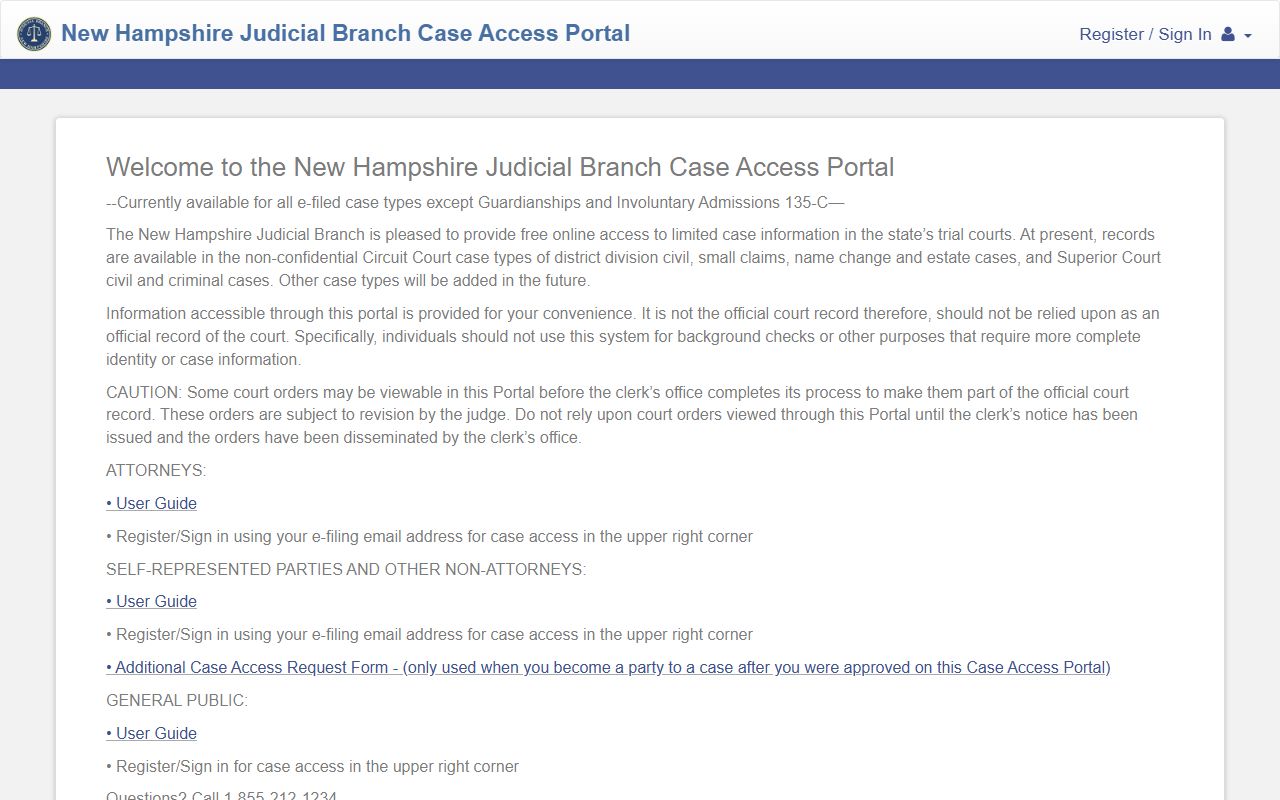
Contested traffic cases appear on the statewide portal once the DMV forwards the ticket to court. The official NH Case Access Portal is shown here:
A preset-fine ticket paid to the DMV will not appear here, because it never became a court case. Use the table below for the portal fields that apply to a traffic case search.
| Field Label | Type | Required | Notes |
|---|---|---|---|
| Smart Search | Text | Yes | Search once a court case exists. |
| Case Number | Text | Optional | Assigned only after DMV sends a not-guilty ticket to court. |
| Party Name | Text | Optional | Driver or defendant name. |
| Filter by Location | Dropdown | Recommended | Brentwood, Candia, Derry, Hampton, Portsmouth, or Salem. |
| Case Type | Dropdown | Optional | Traffic, violation, or criminal labels. |
| Date Range | Date filter | Optional | Use for broad name searches. |
Which Courts Handle Traffic Cases in Rockingham County
Most Rockingham County traffic and motor-vehicle violation cases route through the Circuit Court District Division. The 10th Circuit District locations include Brentwood, Candia, Derry, Hampton, Portsmouth, and Salem. More serious motor-vehicle crimes, such as felony-level DWI or aggravated offenses, can appear in Rockingham Superior Court. The court that hears the case depends on the offense level.
The DMV is not a court. It collects preset-fine payments and keeps the driver record, but it does not hold trials. When a driver contests a ticket, the DMV forwards it to the District Division, which then schedules the case. That hand-off is why a contested ticket can take several months before a court date.
Types of Traffic Cases on Record
Traffic cases range from minor violations to criminal charges. The level controls the court, the penalties, and whether the case leaves a criminal record. A speeding ticket is a violation. A DWI is a criminal charge. Both can produce a court record if they go to court, but the consequences differ sharply.
- Preset-fine violations. Common moving violations with a set fine; can be paid to DMV without a court record.
- Contested violations. Not-guilty tickets sent to court for a pretrial conference and possible trial.
- Misdemeanor motor-vehicle offenses. Including DWI, which carries criminal consequences.
- Felony-level offenses. Aggravated or repeat impaired-driving cases that may reach Superior Court.
Whether a ticket leaves a court record depends on how it is handled. The preset-fine guilty path to the DMV leaves no court record, while the contested path does.
What Rockingham County Traffic Court Records Show
When a traffic case reaches court, the file shows the standard case fields plus traffic-specific detail. The table below lists the fields a contested or criminal traffic record typically includes. A DWI file adds an acknowledgment-of-rights form and plea paperwork.
| Field | What It Shows |
|---|---|
| Court Name | The 10th Circuit District location or Superior Court. |
| Case Name | State v. the driver in a criminal traffic matter. |
| Case Number | Assigned when the DMV sends a not-guilty ticket to court. |
| Charge | The violation or offense, such as DWI 2nd, a Class A misdemeanor. |
| Plea | Guilty, no contest, or not guilty. |
| Pretrial / Trial | Pretrial conference and trial dates and outcomes. |
| Disposition | Fine, finding, default, or dismissal. |
| Counsel Status | Represented by a lawyer or waiver of counsel. |
Searching by Citation Number vs by Name
A traffic case can be searched by case number or by driver name once the court has the case. The citation number on the ticket is not the same as the court case number. The court case number is assigned only after the DMV forwards a not-guilty ticket. If you only have the citation, call the court to confirm whether a case number exists yet.
Searching by name returns every matching court case, so a common name can produce a long list. Filtering by the right 10th Circuit District location trims it. A name search will not turn up a preset-fine ticket paid to the DMV, because that ticket never became a court case.
Paying or Contesting a Rockingham County Traffic Ticket
The path you choose decides whether the ticket leaves a court record. The NH Circuit Court Motor Vehicle Plea by Mail checklist lays out the steps. Read the back of the ticket first, since payment instructions for the DMV are printed there.
- Read the back of the ticket. Preset-fine guilty or no-contest payments go to the DMV within 30 days, and the court keeps no record if paid this way.
- To contest, send the not-guilty plea as instructed; the DMV forwards the ticket to court.
- Wait for the mailed pretrial conference notice, and keep your address current with the court.
- Attend the pretrial conference and speak with the prosecutor; the case may be amended, the plea changed, or not prosecuted.
- If unresolved, attend trial before a judge with evidence and witnesses.
- Pay any fine the day of court if found guilty or changing plea; raise an inability to pay before the plea step.
- File a written motion to continue if you cannot appear.
If you change your plea and pay after the ticket reaches court, payment goes to the court, not the DMV. Contact the court first to confirm the ticket arrived from the DMV.
Note: Missing a pretrial conference or trial can lead to an administrative guilty finding, a fine due for the full amount, and a license suspension.
Public Access Laws for Traffic Court Records
Traffic court cases are court records, governed by Judicial Branch rules rather than only by RSA 91-A. A contested or criminal traffic case appears in the Case Access Portal summary like other cases. The driver record kept by the DMV is a separate file with its own access and confidentiality rules. Criminal history information held by the State Police is confidential and separate again.
For a DWI or other criminal traffic matter, the same access rules as other criminal cases apply. Adult records are generally open through the portal, while sealed and annulled records under RSA 651:5 are not. Juvenile motor-vehicle matters are confidential.
Court Traffic Record vs State Driver Record
This is the distinction that confuses the most drivers. The court traffic record exists only when a ticket goes to court. The DMV driver record tracks convictions, points, and license consequences regardless of how the ticket was handled. They are different files held by different agencies, and they answer different questions.
| Court Traffic Record | State Driver Record (DMV) | |
|---|---|---|
| Source | Circuit Court District Division or Superior Court | NH DMV |
| Exists When | Ticket is contested, criminal, defaulted, or court-referred | For convictions and license actions, even from preset-fine payments |
| What It Shows | Case number, charge, plea, pretrial, trial, disposition | Convictions, points, license status and suspensions |
| Where to Access | Case Access Portal or court clerk | NH DMV driver-record request |
If a preset-fine ticket was paid guilty to the DMV within 30 days, the court has no record of it, but the DMV record may still reflect the conviction and any points. To see the full picture, you may need both files.
CDL and Commercial Driver Records
Commercial drivers face stricter rules. A traffic conviction can affect a commercial driver's license more severely than a regular license, and some convictions cannot be deferred or hidden for CDL holders. A CDL driver should treat a traffic ticket carefully, because the consequences reach the commercial driving record and employment.
The court traffic record and the DMV driver record both feed into how a CDL is affected. For a CDL question tied to a specific charge, the court file shows the disposition, while the DMV record shows the license consequence. An attorney experienced with CDL matters can explain how a plea affects the commercial license.
DUI and DWI Cases in Rockingham County
DWI is a criminal charge, not a simple violation. A DWI case follows the criminal track. The Judicial Branch uses an acknowledgment-of-rights form for misdemeanor DWI, such as a Class A misdemeanor DWI 2nd offense. That form lists the rights a defendant gives up with a guilty or no-contest plea, including the right to a trial, to confront witnesses, and to remain silent. It also notes immigration consequences for noncitizens.
Serious or repeat impaired-driving cases can reach Superior Court at the felony level. Because DWI is criminal, it can leave a criminal record with consequences for jobs, licensing, and immigration. For the broader criminal-record framework and annulment rules, see the arrest records page.
Deferred Adjudication and Defensive Driving
Some drivers ask whether a course or a deferral can keep a ticket off the record. New Hampshire's preset-fine path already keeps a paid violation out of the court record, though the DMV record may still show it. For contested cases, a prosecutor at the pretrial conference may amend the charge or decline to prosecute, which changes what the record shows. Options depend on the offense and the prosecutor's discretion.
There is no single statewide guarantee that a course erases a ticket. The outcome is decided in the case. The financial-affidavit step in the checklist exists for drivers who cannot pay a fine in full on the day of court, which sets a payment due date rather than removing the fine.
Sealing or Expunging Traffic Records
New Hampshire uses "annulment" rather than "expungement" for clearing criminal records, including criminal traffic matters like DWI. Under RSA 651:5, an eligible person petitions the sentencing court after a waiting period that varies by offense class. A simple preset-fine violation handled through the DMV is a different situation, since it never became a court conviction record.
A DWI annulment follows the same waiting-period and eligibility rules as other criminal annulments. The DMV driver record and any license consequence are separate from the court annulment, so clearing the court record does not automatically change the driver record.
Fees for Traffic Record Copies
Fees for traffic court records follow the court schedules, not a single flat rate. A court record search and certified copy come from the Judicial Branch. A DMV driver record comes from the DMV with its own fee. The two are billed separately because they are different files.
| Item | Fee Source |
|---|---|
| Court record search per name | $20 (NHJB service-center language) |
| Certified copy of a court disposition | Judicial Branch fee schedule; confirm with clerk |
| DMV driver record | NH DMV driver-record request fee |
Confirm the current court fee with the clerk before mailing payment. The DMV sets its own driver-record fee, which is the right source for license and conviction history.