
The Right-to-Know Law and Rockingham County Public Records
New Hampshire's open-records law is RSA Chapter 91-A, the Right-to-Know Law. It defines governmental records as information created, accepted, or obtained by or for a public body or agency for official functions. RSA 91-A:4 gives citizens the right to inspect and copy governmental records during regular business hours unless the law prohibits it. The chapter also covers electronic records and allows copies in standard formats while protecting confidential material.
Rockingham County administrative records fall under RSA 91-A. That includes commission minutes, annual reports, budgets, department reports, and facility-use forms. Court case files are different. They run through Judicial Branch rules and case-specific statutes, not RSA 91-A. The same event can produce records on both sides: a sheriff's incident report is a county record, while a court arrest-warrant return becomes part of the court file.
The law leans toward access. It treats the right to inspect as the default and exemptions as the exception. An agency cannot refuse a request just because filling it takes effort. It must point to a specific reason in the statute to withhold a record. That balance matters in a county where records are spread across many offices and many buildings on the Brentwood campus.
County Records vs Court Records in Rockingham County
The most common mistake is asking the wrong office. The county clusters its offices around the Brentwood campus, but they hold different records. Going to Corrections for a court copy, or to the Register of Deeds for a divorce certificate, wastes a trip. The table below shows which office holds which record.
| Record Needed | First Official Office |
|---|---|
| Superior Court felony or civil case | NH Case Access Portal / Rockingham Superior Court clerk |
| Misdemeanor, small claims, landlord-tenant, traffic case | 10th Circuit District Division |
| Divorce, parenting, custody case | 10th Circuit Family Division |
| Estate, will, guardianship, probate | 10th Circuit Probate Division (code 318) |
| Deed, mortgage, plan, lien recording | Rockingham County Register of Deeds, 102 North Road |
| Marriage certificate | City or town clerk, or NH Division of Vital Records |
| County budget, minutes, reports | Rockingham County, Right-to-Know request |
The county publishes a public information page with reports, forms, and a Right-to-Know request form. The official page is shown here:
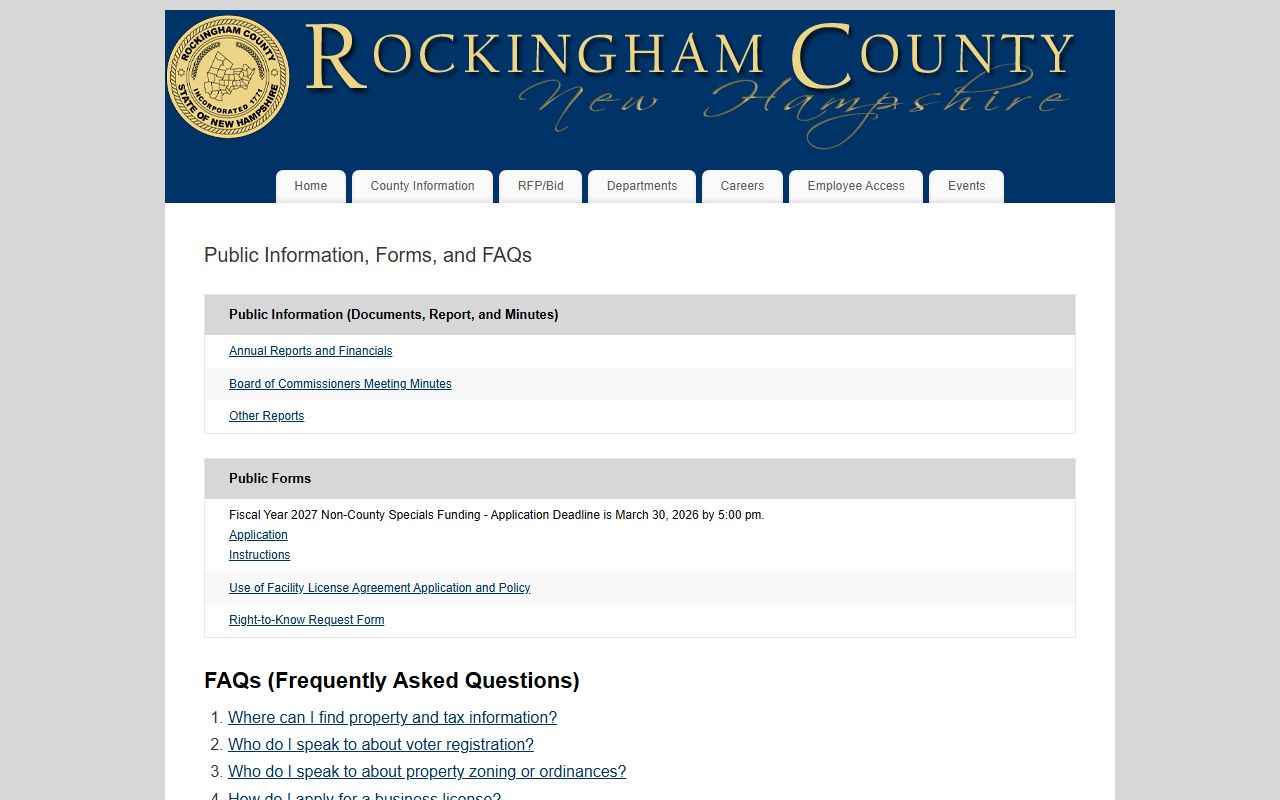
Use this page to find the county Right-to-Know request form and the reports the county already publishes online.
How to File a Rockingham County Right-to-Know Request
A Right-to-Know request does not need a special format, but a clear written request gets a faster, cleaner response. Identify the records you want as specifically as you can. A narrow, well-described request is easier for staff to fill and less likely to trigger a large copy fee.
- Identify the exact records you want, with dates, departments, and document types.
- Use the county Right-to-Know request form from the public information page, or write your own request.
- Submit it to the right county office or the records officer named for that department.
- Ask whether the records are available to inspect for free or only as paid copies.
- If the county withholds part of a record, ask which RSA 91-A:5 exemption applies.
The state Department of Justice publishes Right-to-Know guidance for both public bodies and requesters at the DOJ Right-to-Know page. If a request is denied, the chapter includes remedies, and a requester can take court action for a violation.
A clear request usually includes a few standard pieces of information. The county Right-to-Know request form collects them. The fields below reflect the kind of information that helps staff locate and produce the records.
| Field | What It Asks |
|---|---|
| Requester Name and Contact | Name, mailing address, phone, and email for the response. |
| Records Requested | A specific description of the documents, with dates and departments. |
| Format | Inspection, paper copies, or electronic copies in a standard format. |
| Date Range | The time period the request covers. |
| Delivery Method | Pickup, mail, or email. |
| Date of Request | The date you submit, which starts the response timeline. |
Exemptions and Redactions
Not every record is open. RSA 91-A:5 lists categories exempt from disclosure. They include certain personnel, medical, school, law-enforcement, confidential, and privacy-protected records. When the county withholds or redacts part of a record, it should identify the exemption basis. The requester can challenge that denial through the statutory process.
Arrest records have their own rule. RSA Chapter 594 confirms that an adult arrest record is a governmental record subject to disclosure, with exceptions such as RSA 106-B:14 for state criminal history files. Juvenile records, sealed and annulled records, and active investigative files may be withheld or redacted.
Note: Fees generally cannot be used to block inspection, though the county may charge for copies and allowed costs depending on the record and format.
Fees and Response Timelines
Public-record fees in New Hampshire are not one flat schedule. Court copy and search fees come from the Judicial Branch. Vital-record fees come from the Division of Vital Records. Land-record recording fees come from the Register of Deeds. County administrative copies follow RSA 91-A cost rules. Do not merge them into one generic county fee.
| Record Type | Fee Source |
|---|---|
| County administrative copies | RSA 91-A allowed copy costs |
| Court record search per name | $20 (NHJB service-center language) |
| Vital record search / first copy | $15; additional same-record copy $10 |
| Federal court records (PACER) | $0.10 per page |
RSA 91-A allows inspection during regular business hours and sets out how agencies must respond, including timelines for acknowledging and producing records. Confirm the current process with the county records officer, since the response steps can vary by department.
What the County Clerk and Departments Hold
Rockingham County government runs many offices beyond the courts. The department index lists the Register of Deeds, Sheriff, Corrections, County Attorney, Treasurer, Commissioners, and others. Each holds its own records. Land records sit with the Register of Deeds at 102 North Road. County spending and oversight sit with the Treasurer, Finance, and Commissioners. Sheriff and Corrections hold their own operational records.
The county also runs active budget oversight, with budget subcommittee meetings for the Sheriff, County Attorney, and Register of Deeds. Those meeting records are county records under RSA 91-A. For land, mortgage, and lien records specifically, the Register of Deeds page covers the recording process and fees.
The county department contact table lists separate numbers for each office, which helps direct a request. General Information is 603-679-5335. Corrections Inmate Information is 603-679-2244. The County Attorney is 603-642-4249. The Register of Deeds is 603-642-5526. The Sheriff's Office is 603-679-9475. The Commissioners are 603-679-9350, and Finance is 603-679-9413. Sending a request to the office that actually holds the record avoids delay.
Open Meetings and Public Bodies
RSA 91-A covers more than documents. It also covers meetings of public bodies. County commission meetings, budget subcommittee meetings, and delegation meetings are generally open, with notice and minutes. Minutes of those meetings are governmental records the public can request. Nonpublic sessions are allowed only for specific reasons listed in the law, and the body must state the reason.
For Rockingham County, this means the budgets, minutes, and reports that flow from commission and delegation work are part of the public record. If a meeting record is not posted online, a Right-to-Know request is the route to obtain it. The same exemptions that apply to documents also apply to the parts of meeting records that fall under RSA 91-A:5.