
Rockingham Superior Court Jurisdiction
The Superior Court is New Hampshire's court of general jurisdiction. It handles felony criminal cases, civil actions that need a jury trial or exceed the limited-jurisdiction thresholds, equity matters, and certain appeals from lower courts and agencies. Rockingham Superior Court uses court code 218, which begins its case numbers, such as 218-2021-CR-01330 for a criminal case.
The court sits at 10 Route 125, Brentwood, NH 03833, with mail to Rockingham County Courthouse, P.O. Box 1258, Kingston, NH 03848-1258. The Clerk of Court is Patrice D. Touma, Esq., supported by Deputy Clerk Megan M. Ryan, Esq. and Administrative Clerk Elizabeth J. Chase. The statewide Judicial Branch Information Center number is 1-855-212-1234.
As the general trial court, Superior Court is where jury trials happen in Rockingham County. The Circuit Court divisions do not hold jury trials. That makes the Superior Court the venue for the most contested criminal and civil matters, where a party has a right to a jury or where the dollar amount or charge level requires it. The County Attorney prosecutes many of the felony cases heard here, and the Sheriff's Office provides court security and prisoner transport for the courthouse.
New Hampshire's Court Hierarchy
New Hampshire runs a compact court system with no separate intermediate appeals court. The New Hampshire Supreme Court sits at the top as the appellate court and administrative head of the Judicial Branch. The Superior Court is the general trial court. The Circuit Court is the limited-jurisdiction trial court with District, Family, and Probate Divisions. Federal cases from Rockingham County go to the U.S. District Court for the District of New Hampshire.
| Court | Jurisdiction | Case Types |
|---|---|---|
| New Hampshire Supreme Court | Statewide appellate | Appeals from Superior and Circuit final orders |
| Rockingham Superior Court (218) | General trial, county-wide | Felonies, jury trials, larger civil, equity, agency appeals |
| 10th Circuit District Division | Limited jurisdiction | Misdemeanors, violations, small claims, landlord-tenant, traffic |
| 10th Circuit Family Division | Family matters | Divorce, parenting, child support, domestic violence |
| 10th Circuit Probate Division (318) | Probate matters | Wills, estates, guardianships, name changes |
Because there is no mid-level appeals court, an appeal from Rockingham Superior Court goes straight to the New Hampshire Supreme Court.
The 10th Circuit and Rockingham Court Locations
Rockingham County is the 10th Circuit. The Circuit Court spreads its District and Family Division work across several towns. The Superior Court sits in Brentwood, while the lower-court divisions reach the seacoast and western parts of the county. The table lists the published locations with court codes and addresses where confirmed.
| Court / Division | Code | Address |
|---|---|---|
| Rockingham Superior Court | 218 | 10 Route 125, Brentwood, NH 03833 |
| District - Brentwood | 435 | 10 Route 125, Brentwood, NH 03833 |
| District - Hampton | 441 | 3 Timber Swamp Road, Hampton, NH 03842 |
| District - Portsmouth | 470 | 111 Parrott Avenue, Portsmouth, NH 03801-4490 |
| District - Salem | 473 | 35 Geremonty Drive, Salem, NH 03079 |
| District - Derry / Candia | 431 / 422 | Verify on NHJB location directory |
| Probate Division - Brentwood | 318 | Brentwood court complex |
The county map for the 10th Circuit shows Rockingham as the 10th Circuit with Brentwood, Candia, Derry, Hampton, Portsmouth, and Salem. Confirm Candia and Derry street addresses on the live court location directory before a trip.
Superior Court vs Circuit Court Divisions
The line between Superior Court and the Circuit Court divisions is mostly about case seriousness and type. Felonies and larger civil cases go to Superior Court. Misdemeanors, violations, small claims, and most traffic go to the District Division. Divorce and family matters go to the Family Division. Estates and guardianships go to the Probate Division.
| Superior Court | Circuit Court Divisions | |
|---|---|---|
| Criminal | Felonies, serious cases | Misdemeanors, violations |
| Civil | Larger civil, equity, jury trials | Small claims, landlord-tenant |
| Family | Generally not | Divorce, parenting, child support |
| Probate | No | Wills, estates, guardianships |
This split is why the court code at the start of a case number matters. The code tells you which court holds the file, which is the first step in any Rockingham County case search.
How a Case Moves Through the System
A case moves up the hierarchy as it progresses or is appealed. A criminal case may start with a charge in the District Division and move to Superior Court for a felony. A civil dispute filed in Superior Court ends with a judgment that can be appealed. The basic flow is short because New Hampshire has no middle appeals court.
Case flow: Circuit Court District, Family, or Probate Division › Rockingham Superior Court › New Hampshire Supreme Court
At each step, the file stays with the court that has jurisdiction. The Superior Court clerk keeps the Superior Court file. The Supreme Court keeps the appeal record. The Case Access Portal indexes the trial-court cases, while Supreme Court matters appear on the Judicial Branch site.
What Rockingham Superior Court Records Contain
A Superior Court file holds the full record of a serious case. On the criminal side, that includes the indictment or information, arrest warrant, bail order, plea papers, sentencing order, and probation conditions. On the civil side, it includes the complaint, motions, exhibits, orders, judgments, and any writ of execution. Equity matters add injunctions and other relief.
Most adult criminal and civil records are open through the Case Access Portal, but the documents themselves often require party or attorney access. Sealed and annulled records stay off the portal. Grand jury records are confidential. The public summary view shows the docket, parties, and hearings, while certified copies of judgments and orders come through the clerk.
Searching a Superior Court case starts with the court code 218 and the year, then the case category and sequence. A criminal case reads like 218-2021-CR-01330. Knowing the code confirms the case is in Superior Court rather than a Circuit Court division, which speeds the search and avoids false matches on a common name.
Visiting Rockingham Superior Court
The court sits on a county campus in Brentwood, where the courthouse, Registry of Deeds, County Attorney, Sheriff's Office, and Corrections share addresses on Route 125 and North Road. Visitors should confirm which building they need before leaving home, since the addresses are close but not interchangeable. The Sheriff's Office provides court security and screening at the Superior Court.
Rockingham Superior Court
10 Route 125
Brentwood, NH 03833
Mail: P.O. Box 1258, Kingston, NH 03848-1258
1-855-212-1234
Clerk: Patrice D. Touma, Esq.
Jurors should bring photo ID and the summons. The Judicial Branch uses TTY/TDD Relay 800-735-2964, and accommodation requests go through the Information Center at 1-855-212-1234 before the hearing date. Confirm device and recording rules in advance, since local pages do not publish a full list.
The county publishes a directions page for the Brentwood complex. The official county directions page is shown here:
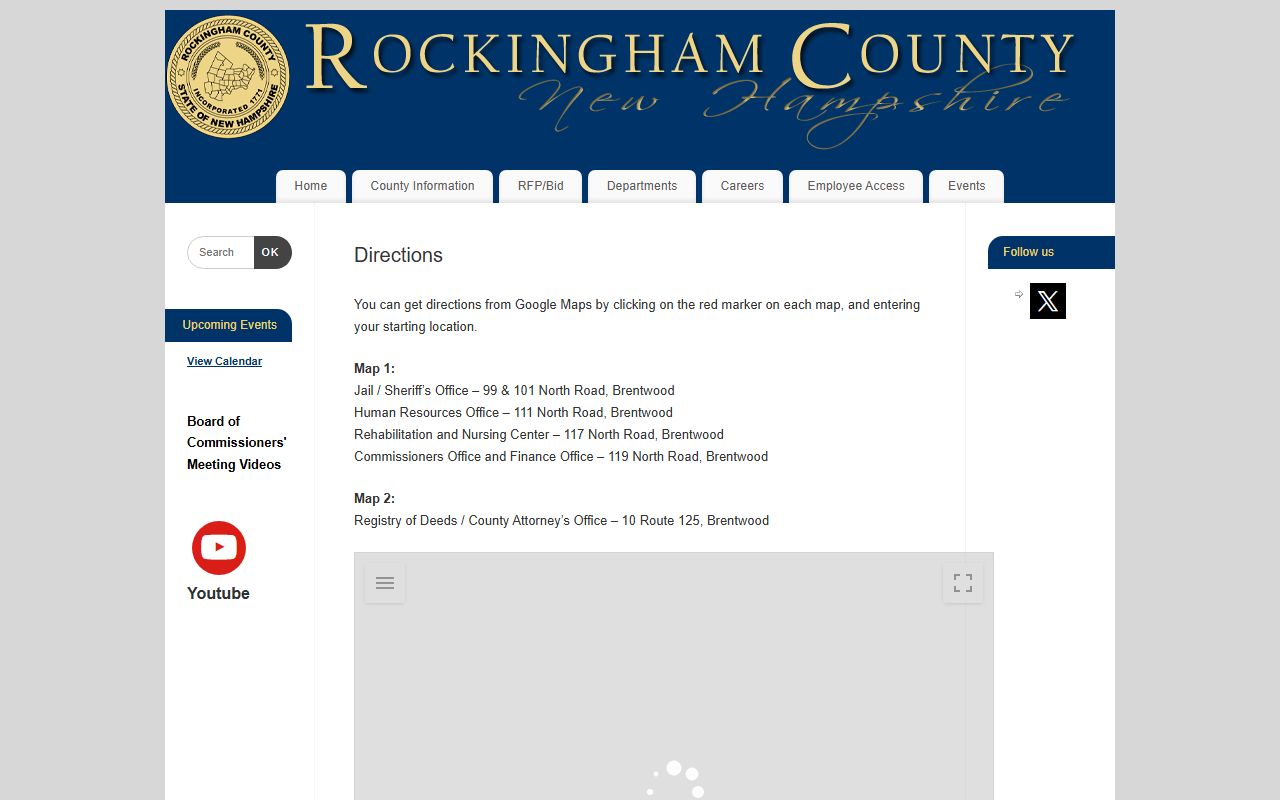
Because the courthouse and county offices use both Route 125 and North Road addresses, the directions page helps confirm which building serves your court division.
Court History and Structure
Rockingham County was organized in 1769 and incorporated in 1771, one of New Hampshire's five original counties. Portsmouth and Exeter held early state-government roles before Concord became the capital in 1808. New Hampshire's modern Circuit Court was created in 2011 under RSA 490-F, consolidating district, family, and probate functions into a single Circuit Court. Rockingham became the 10th Circuit.
A recent operational note shows how procedure affects the courts. The end of the Felonies First Program in December 2023 contributed to a more than 18% rise in Sheriff transports in FY 2024. That reflects a process change in how felony cases move, not a measure of crime or convictions.